From left to right, released in 2003, 2004, and 2006
Potential Peak Oil Fallout & Recognition Will Once Again Get Obfuscated, this Time by the Strait of Hormuz Crisis
While the current situation will effectively mask/defer the peaking of conventional & unconventional oil supplies, expect us to inadvertently squander yet another opportunity to learn about limits & energy contraction. Here's some recommended resources that can assist you in avoiding that outcome.
Back in early-2020 it could be widely read that SARS-CoV-2 would be over in a few months. A couple of years later we were then reassured that the invasion of Ukraine would be over in a few days (in favour of Russia). Now? Now we're being told this is "day 17" or what have you of the Strait of Hormuz crisis.
On the contrary, if we want to take heed of the seriousness of what's unfolding (and there's a good chance this is gonna get really, really bad), then it'd probably be in our best interests to call this for what it is. Not "day 17", not "week three", but month one. And if any of us remember what mid-2020 turned to be like, we can either take the time to prepare (so much as our limited individual and collective situations may allow for at this late stage) or we can blissfully continue to ignore all the warnings around us and keep on living as if it's still 2019.
But while this was initially going to be a quick piece recommending to neophytes a few of the resources that contributed to enabling some of us to foresee events like this Strait of Hormuz crisis decades in advance, reviewing a few recent questionable statements by ecological economist Nate Hagens and geologist/energy analyst Art Berman seem appropriate, seeing how doing so might bolster the argument of needing to specifically go out of our way to inform our friends, family and fellow citizens of the backstory of energy depletion in the hopes that all the aforementioned people can better understand the currently unfolding crisis.
Blinders 'R us
As I was finishing up writing the recommendation portion of this piece a few days ago and then was getting ready to publish it, Nate Hagens released his latest Wide Boundary News update, suggesting that exactly what I argued wouldn't happen would in fact happen. To explain that, and to start off this post's partial re-write and expansion, here's the most relevant bit Hagens had to say:
My read is just like the Ukraine war was for Europe, this incursion is going to remove the energy blinders for a much wider portion of our society, we may now be facing an energy access problem. And as a society, we have almost no intuition for what that actually means because we've trained ourselves to think about energy in terms of cost when we should have been thinking about it in terms of benefits and dependency. We are energy blind.
On the contrary, I unfortunately tend to think the exact opposite – that those "energy blinders" are going to get strapped on ever harder coming out of this latest crisis, perhaps even updated with energy-dependent Meta Ray-Ban AI Glasses or with Apple's AI Smart Glasses expected sometime later this year (although we'll have to see if acute shortages of natural gas, helium, and other feedstocks will preclude high-end manufacturing of such products, which is a very real possibility at this point). Because while Hagens doesn't explain why exactly those energy blinders are going to be "removed" for a "much wider portion of society" (emphasis mine), it's hard to see why that "removal" will occur for anything more than a tiny fraction of society.
Meta AI glasses, the next evolution in energy blindness (source: Facebook)
Berman, however, seems to have inadvertently provided the rationale for that "removal", courtesy of a piece of his entitled "The Iran War: A World-Changing Event".
There may, however, be one unexpected benefit. This crisis may finally force recognition of how vulnerable our civilization really is—not just to energy disruption but to the fragility of supply chains, agriculture, and geopolitics.
Humans rarely change behavior except under extreme stress.
This situation of changing under extreme stress is certainly true, exemplified by the notion of one needing to hit the proverbial "rock bottom" before being able to change one's ways. There is, however, a big problem here. There's a decent chance that while an alcoholic would get reminded by non-alcoholics that they must quit the drink, there would also be a decent chance that a drug addict would have a slew of non-addicts encouraging them to get off the smack. However, the fact that those of us living in modern industrial society – which means you, me, and virtually all of our peers – were born into a world of easy access to cheap and plentiful energy inherently implies that everybody else around us similarly sees our current "addiction" as perfectly normal. Like the fish that doesn't realize it's swimming in water, we largely don't realize we "swim" in cheap and plentiful energy. Moreover, being the oblivious "addicts" that we are, many of the vociferous calls being made claiming that the current crisis is even more proof of the need to transition away from fossil fuels to renewable energies does little to nothing to address our behaviour. In fact, it's not too much different from the heroin addict being encouraged to "transition" over to methadone, problem solved, end of story.
Seeing how the notion that the extreme stress that will likely come about from this current crisis will make us change our behaviour (in a proactive manner rather than a reactive one) isn't all that much different from thinking that humanity was about go through a consciousness change on December 21st 2012 because the Mayan calendar was resetting, let's take a look at the concept of Hagens' aforementioned "energy blindness" to see why exactly this might not happen. And seeing how the best place to understand its definition is directly from the horse's mouth, here's how Hagens himself defines "energy blindness":
Energy blindness is the fact that our society misunderstands energy in its role in our current living and our expectations. There are four aspects.
One is that energy underpins everything in nature and everything in human systems. We need energy for everything.
Number two that we don't realize the scale of how much energy we use. Effectively four to 500 billion human workers equivalent of fossil energy.
The third is that this stuff is depleting very rapidly, and culturally we're treating it as if it were interest but it's actually a principle – a bank account – that is being drawn down millions of times faster than it was built up.
And the fourth aspect of energy blindness is that when we burn all this energy to give us the modern conveniences and transport and consumption, there is a pollution and a waste that comes with that.
And I think our cultural stories don't include any of that, and yet so much of our future and our expectations and institutions and culture depend on energy. So we're energy blind.
In terms of #4, we're pretty much already there. Although there's a sizable amount of climate-deniers and the like that disbelieve the scientific findings and who are stuck in their ways, it's been broadly accepted in scientific circles that the burning of fossil fuels causes pollution and thus alters the planet's climate by way of CO2 released into the atmosphere. With virtually everybody by now pretty much dug into their positions, there's probably not too much to be done in this respect.
In terms of #1, yes, there may very well be a fair amount of people who come to learn about – to a limited degree – some of the various ways in which energy underpins our modern way of life. For example, curtailment of urea and ammonia exports through the Strait of Hormuz may very well enlighten some people of the fact that natural gas is necessary for the nitrogenous synthetic fertilizer that sustains roughly 50% of people alive today.
However, there's absolutely no reason to think that a significant portion of those "enlightened" people will effortlessly (which is the name of the game in this current fossil-fuelled way of living) gravitate towards an understanding of legume-integrated crop rotations and the need to integrate them into our agricultural systems (mixed, polycultural agricultural systems, which would by no means entail a simple transition from one agricultural system to another), as opposed to being drawn towards calls for greater research into, and a transition towards, technological solutions along the lines of green ammonia.
In terms of #2 it's highly unlikely that there's going to be much realisation about the "500 billion human workers" that fossil fuels provide as, although it's a rather jaw-dropping statistic, it's rather obscure and not commonly spoken about.
#3 – that fossil fuels are depleting – is the doozy of these four aspects of energy blindness, as it's the one that focuses on constraints and thus limits. It's also, by far, the hardest of these four points for most people living in modern societies to come to terms with, largely because were it to be taken to heart it would inherently demand a fundamental re-thinking of our understanding and interaction with the world. Problem is, since our modern way of thinking and all the various stimuli and sources of information we're constantly bombarded with are set up to deny the truths of energy depletion and limits in general, there's no reason to think why the Strait of Hormuz crisis, as Hagens put it, will result in "a much wider portion of our society" "remov[ing] [their] energy blinders" and then accepting the underlying nature of the current situation.
Case in point. At roughly the same time that Hagens' latest Wide Boundary News video was published, a couple of relevant videos were published by Times News (an arm of The Times, one of the largest publications in the UK), one of them entitled "The UK Should Go Back To Drilling For Oil Domestically". In the first of these videos it was argued that there's apparently large amounts of untapped oil available in the United States. In response to the interviewer stating that "[Donald Trump] was stressing that the US has got plenty of oil", the interviewee, a US reporter, replied with:
Well, he's not wrong about that. The US has plenty of identified sites that have not been tapped and explored, which is the decision of the free market. The large oil companies have declined to drill and explore in those sites. This is maybe why the president met last week with the secretary of interior affairs who handles drilling inside the nation. So, domestic production is not – there's a lot of potential for US domestic production, and Trump has removed a lot of the guard rails. But a lot of these oil fields are not being put to purpose.
Anybody that understands the vagaries of the shale situation in the United States knows that that statement if chock full of inaccuracies, largely emanating from depletion rates and the poor quality (low-EROI) of what remains. As it's been otherwise put by many in the know over the past few months, as of late-2025 the shale boom in the United States is over (which will be very briefly explained below).
To make matters worse, the other Times News video simultaneously published was an interview with British historian AN Wilson, someone who stated with a straight face that "there's [still] more [North Sea oil] than we've ever got out before", and even more absurdly that "we now realize there's almost limitless oil". It'd be bad enough if he'd stated that there was limitless oil available (to which we could simply dismiss him as some conspiracy theorist that believed in the theory of abiotic oil), but "almost limitless oil"? What does that even mean? What exactly is a bit less than limitless? Infinity minus a hundred? What even is that? Do these people not hear what's coming our of their mouths?
Such pronouncements of course aren't limited to the UK, the United States' CNBC absurdly trying to insinuate the other day that the highest value that crude oil had ever reached, in July of 2008, was due to the 2003 Iraq war (as opposed to being because global supplies of conventional oil had peaked in 2005, also briefly elaborated on below):
During the years following the Iraq war, global oil prices rose sharply. Oil climbs from around $30 per barrel in 2003 to more than $130 by mid-2008.
With all that in mind, while Hagens' Great Simplification certainly has a much larger audience than From Filmers to Farmers does (for several obvious reasons), it still has a tiny reach in the grand scheme of things. Because while The Great Simplification has one of the largest audiences when it comes to collapse-related topics, the few videos (and written material) it and similar publications release pale in comparison to the amount of videos and articles published by Times News, CNBC, and the hundreds if not thousands of other mainstream publications out there, all of which churn out countless numbers of pieces promulgating the Gospel of (almost) infinite expansion.
In the meantime, while many Europeans (as Hagens put it) certainly clued into many of the ways in which energy plays a more significant part in their lives than they'd realized previous to Russia's invasion of Ukraine, it doesn't however seem as if many of those same people have taken to heart the realities of what French president Emmanuel Macron called – half a year after the invasion of Ukraine began – "the end of abundance". In somewhat of a similar manner, while the International Energy Agency and its 32 member countries agreed the other day to attempt to address supply issues by releasing a third of the group's total government stockpiles (roughly 400m barrels of oil), not a word was mentioned during the announcement about addressing demand (by suggesting people turn down air conditioning and/or heating, by reducing speed limits, etc.). In other words, while the importance of energy in our lives would have been somewhat understood by many people due to the current situation and the action taken, that by no means implies that many people would have in effect come to understand issues of depletion and the like (any more than they did upon Russia's invasion of Ukraine).
Although some countries – out of desperation – are at least making an attempt to reduce demand (Thailand, for example, is telling bureaucrats to take the stairs as well as to work from home while also urging government officials to delay non-essential overseas travel, Danish government officials are pleading with Danes to cut down on driving their cars, the Philippine government is implementing a temporary four-day workweek, kitchens across India are eschewing hot food and tea in order to save on cooking gas, Pakistan is closing schools and implementing a four-day work week, and so forth), it'd be a stretch to assume that any of the aforementioned will contribute to a "much wider portion of our society" "remov[ing] [their] energy blinders", or at least not the part that's crucially needed.
Yes, in response to the oil crises of the 1970s several European countries took measures to address the situation, specifically Denmark creating a wind turbine industry, France establishing a strong nuclear sector, Sweden creating district heating networks and increased insulation, and the Netherlands building the world's premier cycling infrastructure. But besides the cycling infrastructure (and perhaps Sweden's steps to increase insulation), all of the other measures taken were technological rather than behavioural and simply swapped in one source of energy for another.
If the past is anything to go by, and barring any broad-scale concerted efforts (of which nothing appears to exist on any possible horizon), what we're likely to get out this Strait of Hormuz crisis likely isn't what happened after the 2005 peak in global supplies of conventional oil and the ensuing 2008 Global Financial Crisis (a relative explosion in print and online material about peak oil, collapse, limits, and all the rest of it), but rather more like what happened after what was (until recently) the November 2018 peak in global supplies of both conventional and unconventional oil. Namely, a clamouring to return to the heady days of 2019 and prior.
Humanity is “saved” from peak oil by a pandemic
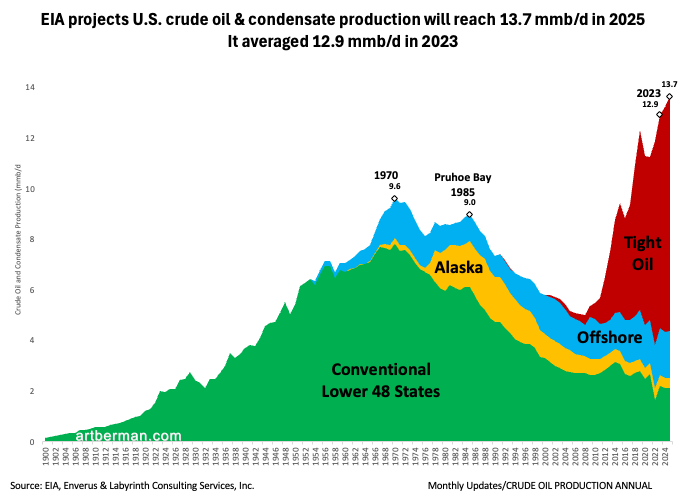
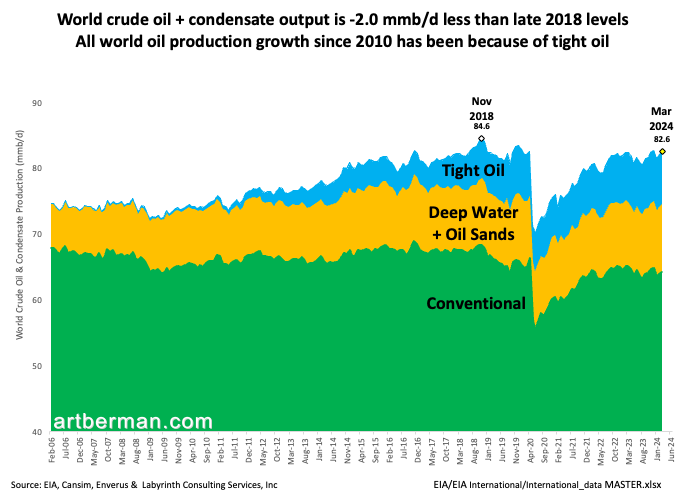
Although we're not going to get into the weeds here about peak oil, EROI, net energy, and other related topics (that's for an upcoming long-form piece being worked on at the moment, put on hold for the writing of this piece and then probably others), for those already familiar with these topics it might be recalled that global supplies of conventional oil peaked back in 2005, after which they proceeded to go through an undulating plateau of which included a few instances more than a decade later in which levels ever-so-briefly surpassed the 2005 peak (the plateau marked with the dashed line above the green portion signifying conventional oil supplies in Figure 1).
The high oil prices that resulted from that initial peak in global oil supplies not only triggered the 2008 Global Financial Crisis (GFC), but they also eventually made investment into the extraction of shale oil (also referred to as light tight oil, which is regarded as an unconventional form of oil) in the United States economically viable. For reasons that won't be delved into here, that tight oil quickly shot up in supply (see tight oil supplies highlighted in red in Figure 2).
Skipping over the brunt of the story (which will be thoroughly elaborated upon in that aforementioned upcoming long-form piece), it wasn't long before the conventional plus unconventional oil supplies hit their combined peak, for several years now that unsurpassed-point having occurred in November 2018 at 84.6 million barrels per day (Mb/d).
While it's possible that that November 2018 peak may have been surpassed a couple of years or so later, it's also just as possible that the combined level of conventional and unconventional oil supplies would have experienced their own undulating plateau for several years, which at the very least would have led to a repeat of the 2008 GFC. We'll never know though, because the short recession brought about by the SARS-CoV-2 pandemic just over a year later (which although no longer in its emergency phase is still going strong, the US now winding down from its 12th wave), which significantly decreased global oil demand, precluded the possibility of a sustained situation of global oil supplies that couldn't meet demand.
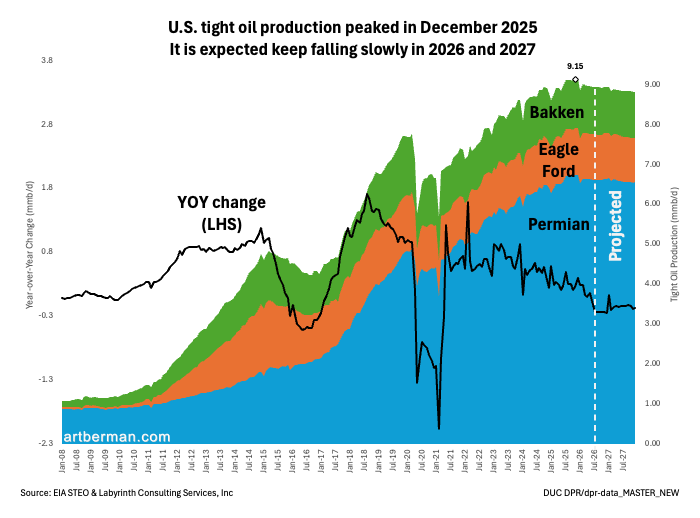
That all being so, while it took more than three years before global oil demand was able to climb back up to pre-SARS-CoV-2 levels (we call it SARS-CoV-2 here, not COVID-19, the latter name brought in to avoid inciting fear and panic in people, something that doesn't bode well for people supposedly being able to willfully "remove [their] energy blinders"), it appears that due to the December 2025 peak of the largest shale play in the United States (the Permian), US tight oil production, in aggregate, has now peaked at 9.15 Mb/d.
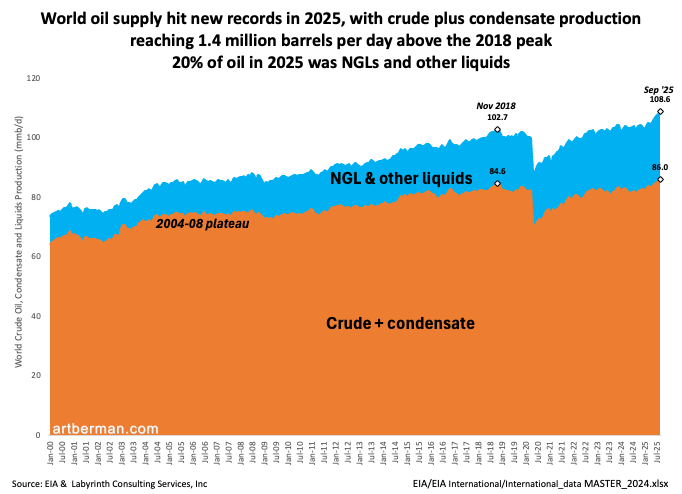
By extension, thanks to that (possibly final) growth spurt by the Permian, conventional plus unconventional oil supplies managed to increase enough in mid-2025 that they were in fact able to surpass the November 2018 peak by 1.4 Mb/d, reaching 86 Mb/d in September 2025 (crude + condensate, orange in Figure 5, includes global supplies of both conventional and unconventional oil supplies, the latter including US tight oil supplies).
That's essentially where we now find ourselves. But unlike what occurred in the 2005-2008 period, and not to suggest some kind of conspiracy, in a similar manner to the way in which SARS-CoV-2's destruction of oil demand and the recession it brought about effectively nullified the possibility of the end of economic growth (emanating from a contraction of energy supplies to power that growth) and thus somewhat of a repeat of the 2008 GFC, the destruction of oil supply via the restriction of Strait of Hormuz tanker traffic is similarly nullifying the possibility that the more recent (September 2025) peak in overall global oil supplies could eventually result in a similar end of growth situation (meaning another all but inevitable recession, likely transforming into a permanent depression).
That is to say, there's no doubt that similar pronunciations to the aforementioned comments made on Times Radio would have been made in response to the eventual slow economic contraction that would have all but surely eventually followed the November 2018 peak in overall global oil supplies (supposing it would have in fact been the final peak, and supposing SARS-CoV-2 didn't occur), and there's also no doubt that the same thing can be said for what would have been the slow economic contraction that would have all but surely eventually followed the more recent September 2025 peak in overall global oil supplies. Nonetheless, as there would have been no blatant catastrophe that would have effectively curtailed supplies, there would have been no scapegoat to pin problems on and thus no easy way to brush off worsening conditions. In effect, and although still small, the unrelenting slow economic grind post-November 2018 or post-September 2025 may very well have allowed for a (slightly better) chance for alternative opinions and voices to creep in and counter accepted dogmas.
That, of course, is not what we have now. Instead, and following what's expected to be an eventual cessation in hostilities (which doesn't seem to be coming anytime soon, although that's another topic for another time), there's going to be a significant amount of oil wells and the like that will need to be brought back online (if not repaired), supply chains that will have to be reconstituted (if not redesigned), businesses that will have to get back on their feet (if not get replaced), etc. Depending on how long the current crisis in the Middle East goes on for, and depending on how much of an economic hit the global economy takes, that means somewhere between months and – more likely – even years of "economic recovery".
In effect, although the economic baseline will have been reduced from its previous level, the name of the game will once again be economic growth, obviating the hard questions that may have been asked had of the current crisis not occurred and had of the September 2025 peak in overall global oil supplies eventually resulted in the slow grind of undramatic global economic contraction. Contrary to Hagens' prediction of "a much wider portion of our society" that will "remove [their] energy blinders", what we're more likely to get is, similar to what occurred courtesy of SARS-CoV-2, some kind of equivalent of people sharing videos on Instagram of the latest loaf of bread they made during lockdown in their new bread maker, that shiny new appliance and any thoughts of some kind of change in behaviour then relegated to some dusty corner or the second-hand store once problems (somewhat) alleviated and restaurants reopened.
So while there are those in collapse circles suggesting that the various constraints beginning to percolate across the world – due to the inability for most tankers and other ships to transit through the Strait of Hormuz – will result in a growing cognizance amongst society about the dire dependency our modern industrial civilisation has on oil and natural gas (not just for transportation and climate control but also for synthetic fertilizers, for the sourcing of sulphur for all its sulphuric acid-based uses, for helium for MRI machines and semiconductor production, and so forth), there's no reason to think that the general approach won't be more of the usual: a deference to calls for expanding the Canadian oil sands (already being looked into) and returning to North Sea oil and gas (already being made), for a quicker restart of the Venezuelan oil industry, for permanently lifting sanctions on Russian oil (current easing of sanctions last for only 30 days), for greater investment into oil exploration, for more research into green ammonia, for greater electrification of transportation (sidestepping the impossibility of electrifying large aircraft and the ecological consequences of electrifying large tractors), and all sorts of smug takes on social media by brain-dead influencers and the like that ultimately do little more than display the utter ignorance that most people have when it comes to the overall systems effects that will emanate from this crisis (while perhaps earning those influencers some spare change when their monetized brain-dead posts go viral).
BREAKING: California gas prices could possibly surge above $8 per gallon, lawmakers and industry experts warn.
"Winning" is being able to drive up to the collection point in your EV to pick up your weekly food rations
In short, the likely recourse will be to double-down – with the utmost seriousness this time! – on capitalising on our human ingenuity in order to outsmart our way through this predicament, all accomplished by little else than technological fixes and the hope for evermore extraction of fossil fuels. All the while, the realities of limits to growth and overshoot will continue to be ignored. Likewise, information about peak oil, EROI and net energy won't be mentioned and/or explained on television programs nor on 99.999999% of YouTube videos (was that enough 9s?), and we'll once again be left off none the better.
How, then, can "a much wider portion of our society" be expected to "remove [their] energy blinders", as is most certainly needed?
First off, we can at least stop watching the latest narrow-minded video about how the purchase of electric vehicles (which yours truly is not against) could have allowed "drivers [...] to escape volatile petrol costs" (while the rest of the system falls apart around them); the latest time-wasting video about long petrol/gasoline queues; the latest humdrum video about rising fuel costs; the latest asinine video about market volatility and the effects of the Strait of Hormuz crisis on investment portfolios; and perhaps worst of all, the latest utterly embarrassing and deluded video in which the interviewee – chairperson of the British energy supplier Utilita Energy, which serves more than 800,000 customers – states that "if you think back to 2022, we thought that [the natural gas price spike] was a one-in-100-year event, and now we've had the second one in four years" (revealing his complete ignorance to how energy systems work).
And not only because there's other options available.
Some recommended resources
Following avoidance of the above, and supposing you're newish to some of these topics and do in fact want to learn more, perhaps you might be interested in some documentary films – or better yet some written material – that a few of us have not only been watching, reading, and even recommending for literally decades now, but which have contributed to informing the few of us to the point that current circumstances were 100% expected and proved to be not surprising in the ever so slightest. (Although the Strait of Hormuz was by far the most talked about oil chokepoint over the past few decades by energy analysts and laymen alike due to the various geopolitical issues of the area, other chokepoints have included the Strait of Malacca [through which 80% of China's imported oil supplies flow through], the Bab el-Mandeb strait [between Yemen and Eritrea, through which 40% of trade between Asia and Europe passes], the Suez Canal, the Panama Canal, and more.)
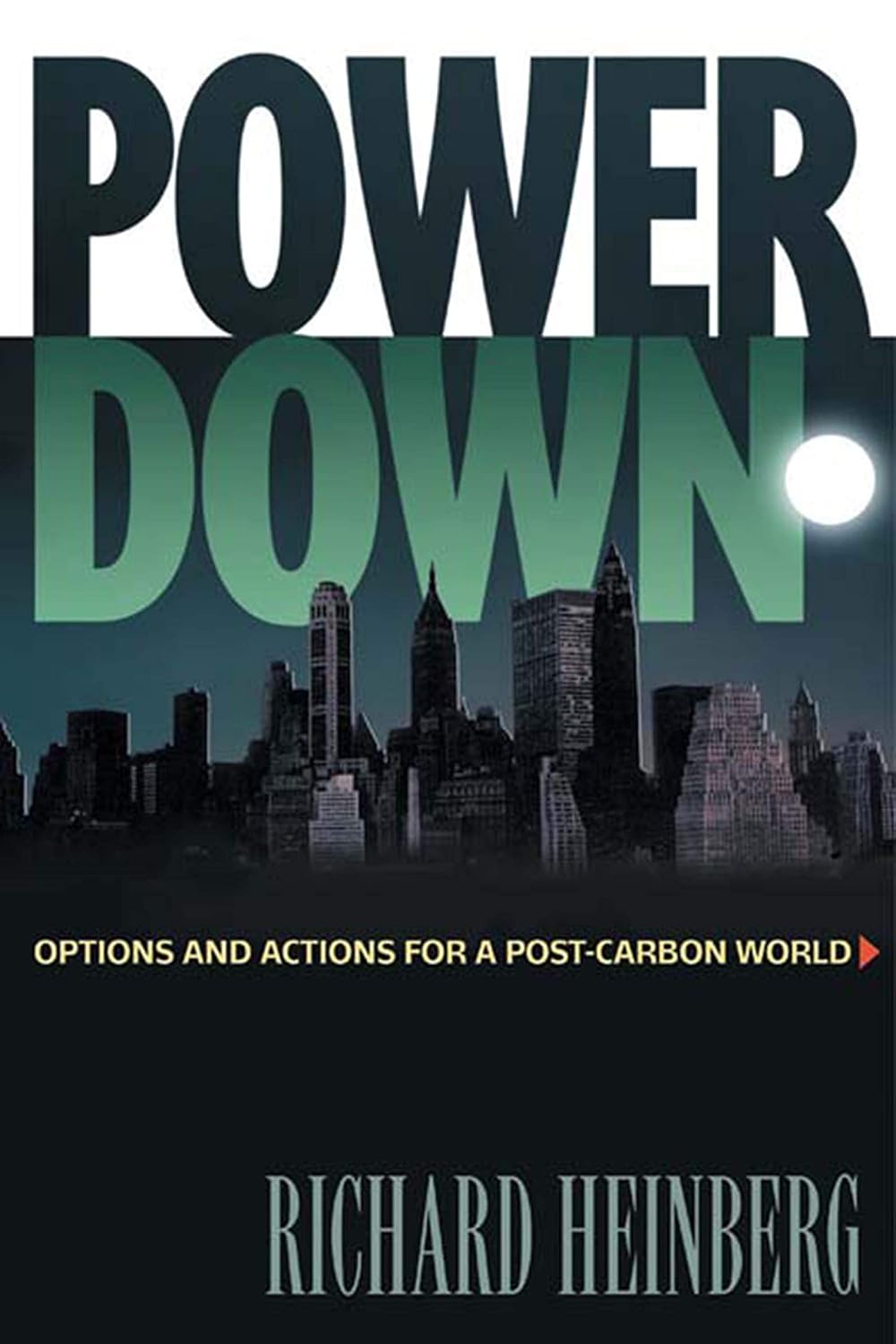
This short list of books is by no means meant to be taken as a list of the best and most informative available, obvious by the fact that the first book depicted above – Powerdown by Richard Heinberg – is mentioned for little more than sentimental reasoning, that being the fact that it's the first book that yours truly ever read about peak oil, back in August of 2005. In it, Heinberg provides an overview of the likely impacts of oil and natural gas depletion, followed by a description of four options that industrial societies might take. If you'd prefer to hone in more closely on the technicalities and history of peak oil, another of Heinberg's two-decade-old books, The Party's Over, depicted in the feature image, might be a better option. (It might be worth noting that there's an updated version of Powerdown to the one depicted above.)
Next up is a book a couple of years shy of being two decades old (there's been a lot of excellent material written on these topics for some time now, which too few of us eagerly lapped up back in the day), this one being The Long Descent by John Michael Greer. One of several of The Long Descent's aspects is its description of the way in which industrial civilisation is following the well-worn path of collapse that has besieged civilisations of the past. Whether or not one agrees or disagrees with Greer's argument of a slow collapse rather than a rapid one, the book provides a rare opportunity for readers to "re-wire" their thinking to something more amenable to present day circumstances.
And finally there's a book which by now is "only" a single decade old, Failing States, Collapsing Systems by Nafeez Ahmed (reviewed back in 2017 here on FF2F). The core premise of the book is that the escalation of political instability and social protest around the world is related to the thermodynamics of global hydrocarbon energy contraction and various interconnected economic consequences. Core collapse-related concepts are explained, including the aforementioned peak oil, EROI and net energy. The book can be read and even downloaded for free here.
Those should be more than enough to familiarize the neophyte to various collapse-related topics, and perhaps even get you or someone you know started in exploring these topics further.
If one is more predisposed to short-form reading, particularly online, the recent newcomer Balázs Matics, writing as the Honest Sorcerer, comes highly recommended. He writes from the perspective of an industrial product engineer by training, with two decades of experience in manufacturing, supply chain, and project management at various multinational corporations. Like many in this realm of collapse, he writes about energy, economics, industrial materials, and various other topics related to the future of civilization.
For a short introduction to Matics and his thinking, he recently did an interview with Nate Hagens over at The Great Simplification in which he jettisoned his erstwhile pseudonymous identity while elucidating on various collapse-related topics. Well worth a listen/watch.
For those more inclined towards audio-visual material, although yours truly gave up watching film and television back in 2006 and so can't speak about anything made since, the last DVD I ever purchased (in April of 2006) was the documentary The End of Suburbia. With my birthday being in June I surreptitiously corralled more than a dozen people over to my place to watch it, the (expected) responses doing nothing to engender expectations that we'd proactively adapt ourselves to unfolding events, instead confirming suspicions that denial would set in hard. The four responses received directly after the viewing were:
"Oh sure, they can fly planes to all their conferences but we're not allowed to fly"
"Don't worry, the government will figure something out"
"They're all a bunch of communists!"
And finally:
"This is boring"
Yes, The End of Suburbia, made in 2004 (and filmed in the region in which yours truly grew up in, no less), was made up of a lot of talking heads. And while much of the information may be dated by now and a few of the estimations turned out to be incorrect (those interviewed of course couldn't have foreseen the emergence of the US-based shale revolution, as none of the rest of us did either), the array of societal predictions made by its various speakers are uncanny to situations we see unfolding today. That all being so, it's safe to say that 20 years after that birthday viewing, things certainly aren't boring anymore!
Next up is the 2006 documentary A Crude Awakening. This one contains less (but still many) talking heads, and while interspersed with various news and commercial footage, the fundamental question the film asks is "What happens when we run out of cheap oil?" For those who didn't watch the film back in 2006 (or who didn't in one way or another expose themselves to similar material a decade or two ago), well, better late than never so start contemplating that question.
As an aside, I can actually say that the (expected) leader of one of Canada's federal political parties, Avi Lewis (of the NDP), has likely seen the latter film, seeing how he and two of his friends (which didn't include his wife, author Naomi Klein) were standing in line behind me on Bloor Street outside of the Bloor Cinema (which apparently has since been renamed to the Bloor Hot Docs Cinema and then the Hot Docs Ted Rogers Cinema) the night I first saw it back in September 2006 (which was also the last film I ever saw in a theatre). It's possible they simply entered the theatre in order to purchase some popcorn before vacating, but that's probably unlikely. Whether or not the topics covered in A Crude Awakening informs Lewis' thinking I can't say, but keeping knowledge about peak oil and societal collapse in consideration when reviewing Lewis' policies (should he win his party's nomination later this month) may shed some light on how a politician reacts (or fails to react) to unfolding circumstances.
Although neither film mentions the Strait of Hormuz, both films are certainly still recommended (supposing that, unlike me, you actually still watch films), but if you have time for just one, The End of Suburbia is the one to watch. Meanwhile, if you have time for just one of the above books, I'd recommend The Long Descent.
That all being so, perhaps you might be interested in screening one or even both of those films with some friends and/or family members in the not too distant future. For as Hagens stated in his latest Frankly, published just a few days after the aforementioned Wide Boundary News update,
[W]ith these sorts of episodes [about "uncomfortable questions"], I invite you to discuss these questions in a group. And after the last one, I got numerous emails – including pictures of people in groups and convenings, discussing the questions and also some Franklies or even podcasts. And this was super encouraging to hear because it will take a village, and lots of them.
And that's really what we're doing here, extending and normalizing the conversation, about our system and what's ahead.
Because who knows? With the situation the world currently finds itself in, perhaps you might have more luck with a more receptive audience than I experienced those 20 birthdays ago.








 Balázs Matics


















Comments